
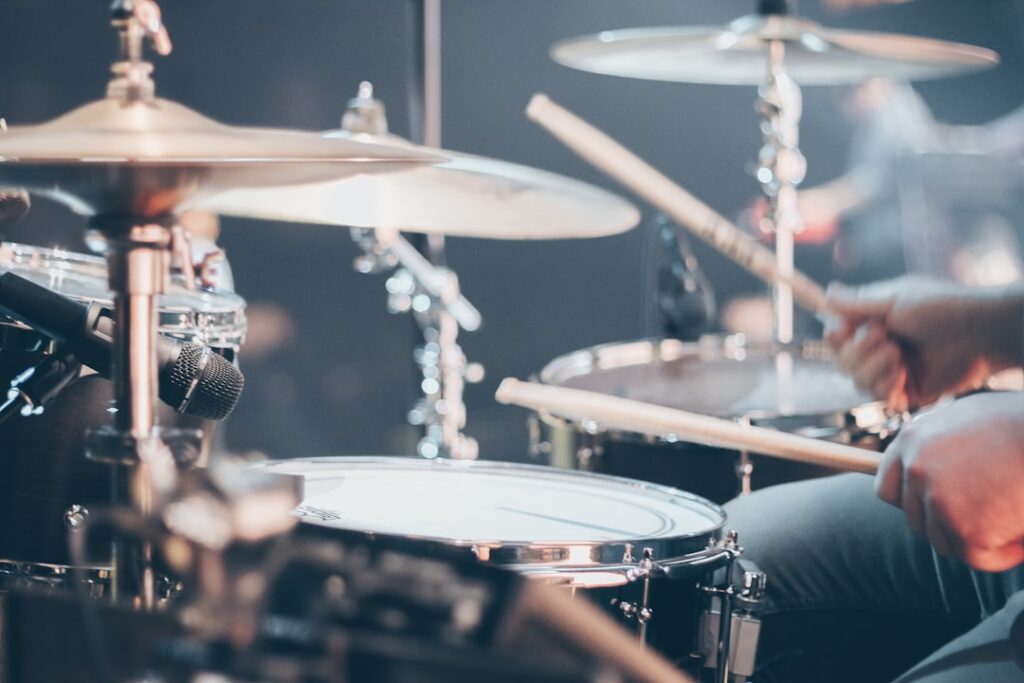
Hand technique can feel confusing because drummers often use different names for similar motions. Terms like German grip, French grip, rebound stroke, Moeller stroke, and push-pull get thrown around constantly, yet many players still struggle to apply them in actual grooves and fills.
The simplest way to make sense of it is to focus on natural body mechanics. Good technique should help you play with more control, better dynamics, less effort, and lower risk of tension or injury. For most drummers, the core skills come down to a solid grip and four key motions: wrist strokes, finger strokes, whipping strokes, and push-pull.
Why hand technique matters
Good hand technique is not just about speed. It affects nearly every part of your playing:
- Control for grooves, fills, and accents
- Efficiency so you do not muscle through every note
- Dynamics so loud and soft notes feel intentional
- Endurance during longer practice sessions or performances
- Relaxation so your arms and hands work with the stick instead of fighting it
If your hands feel stiff, your fast notes collapse, or your grooves sound flat, the issue is often technical rather than musical.
Start with a simple, relaxed stick grip
Before looking at stroke types, it helps to clean up how you hold the sticks. The goal is not to squeeze. You want enough contact to control the stick while still allowing it to rebound naturally.
A practical starting point looks like this:
- Open the hand
- Place the stick into the fuller part of the hand
- Rest the thumb on the stick
- Wrap the remaining fingers around it
This gives you a secure hold without excess tension. If you are gripping too tightly, the stick cannot move freely and every stroke becomes harder than it needs to be.
German, French, and American grip explained
These grips describe the general hand position and the kind of motion you use to move the stick. They are not separate worlds. In real playing, there is a lot of overlap between them.
German grip
German grip places the hands more over the sticks. The motion is primarily up and down, driven by the natural hinge of the wrist.
Think of it like bouncing a basketball. It is direct, simple, and useful in many situations.
Best for:
- General groove playing
- Strong, clear strokes
- Players developing basic control
French grip
French grip rotates the hands inward so they sit more underneath the sticks. The motion is more rotational, similar to turning a doorknob.
This position gives the fingers easier access to the stick and can feel more efficient for lighter, quicker playing.
Best for:
- Ride cymbal patterns
- Hi-hat work
- Fast note groupings
- Lighter cymbal articulation
American grip
American grip is often used to describe the in-between space between German and French. It blends wrist control with some rotational freedom.
Many drummers spend a lot of time here, even if they do not think about it in those terms.
Which grip should you use?
Most drummers use some version of German or American grip most of the time because those positions feel straightforward and stable. French grip becomes especially useful in practical kit situations.
For example:
- On the ride cymbal, French grip can keep the arm more relaxed by your side
- On the hi-hats, it can move the right hand slightly back and create more room for the left hand to play the backbeat
- On cymbals in general, it can help you play lighter and faster
A smart practice method is to play simple patterns and gradually shift between German and French positions. That helps you feel which muscles each grip uses and teaches you that technique exists on a spectrum, not in rigid categories.
The 4 essential hand techniques for drummers
Once your grip is reasonably comfortable, the next step is learning the four foundational stroke types.
1. Wrist strokes
With wrist strokes, the stick stays fairly secure in the hand while you move it up and down using the wrist and forearm muscles.
Strengths:
- Excellent control
- Clear, deliberate strokes
- Useful for building a reliable foundation
Limitations:
- Less efficient at higher speeds
- Can become too muscular if overused
Wrist strokes are important because they teach you how to guide the stick cleanly. They are often the first layer of hand control that drummers build.
2. Finger strokes, also called rebound strokes
Finger strokes use the thumb and index finger as the fulcrum, while the back fingers help pull the stick down. After the stick hits the surface, you allow it to rebound naturally.
This is sometimes described as a free or rebound-based stroke. The stick does more of the work for you.
Why finger strokes matter:
- They improve efficiency
- They help with speed
- They reduce the need to muscle every note
- They make better use of natural rebound
Because the fingers involve smaller muscle groups than the wrist and forearm, they can move more quickly. That makes finger strokes especially useful when the tempo rises.
Important note: wrist strokes and finger strokes are the basic building blocks behind almost everything you play. If those two are weak, the more advanced motions will never feel fully comfortable.
3. Whipping strokes, also known as the Moeller stroke
Whipping strokes add arm motion to the equation. Instead of moving only straight up and down, you create a flowing motion that uses the weight of the arm and a natural whip through the hand.
The basic idea is:
- Lift the elbow while the hand stays lower
- Drop the elbow as the hand rises
- Let that motion whip the stick back down
This gives you power with less effort because you are using the weight and flow of the arm rather than forcing everything with wrist tension.
Why whipping strokes are such a big upgrade
Many drummers sound stiff when they rely only on isolated wrist or finger strokes. Whipping strokes help create:
- More natural phrasing
- Stronger accents
- Better dynamic contrast
- A more relaxed pulse in grooves
This is especially useful in timekeeping and backbeats. On hi-hats, whipping strokes can make repeated eighth notes feel less robotic and more alive. On the snare, they can produce strong backbeats while making softer notes feel smaller by comparison.
Whipping strokes at different tempos
At a moderate tempo, many drummers combine wrist strokes with whipping strokes for control. At faster tempos, it often makes sense to combine finger strokes with whipping strokes so the stick can move more freely and efficiently.
That shift can help with:
- Fast hi-hat patterns
- 16th note halftime grooves
- Accented single-stroke fills
- More fluid solo phrasing
If there is one technique that often separates stiff playing from expressive playing, this is a strong candidate.
4. Push-pull
Push-pull is commonly used for doubles, triples, and other fast note groupings. It is often made to sound more mysterious than it really is.
A useful way to understand it is to start from open rebound strokes. Pull the stick down with the fingers, let it rebound, and then squeeze the stick into the hand as it hits the surface. That squeeze produces an extra note.
Instead of thinking about a complicated push and pull sequence, think of it as building double strokes by controlling the rebound with the fingers.
What push-pull can do
Once the basic motion is working, changing the rate of the squeeze lets you create different note groupings and rhythms, including:
- Doubles
- Triples
- Swung triples for a jazz ride feel
- Swung singles for shuffle phrasing
Push-pull also opens the door to many common rudiments, including:
- Double-stroke rolls
- Six-stroke rolls
- Paradiddles
- Flams
That makes it highly practical for grooves, fills, and stylistic vocabulary across multiple genres.
How these techniques apply on a real drum kit
Technique becomes useful when it solves musical problems. Here is how these motions commonly show up around the kit.
Hi-hat grooves
For steady hi-hat patterns, whipping strokes can add pulse and feel to repeated notes. French grip can also help keep the arm relaxed and make room for the left hand on the snare.
Push-pull becomes useful when the hi-hat part includes doubles, shuffle-like phrasing, or quick note groupings in funk-oriented patterns.
Ride cymbal timekeeping
French grip is especially practical here because the ride cymbal sits off to the right. The more rotational motion can feel natural and relaxed, and it supports lighter articulation with quicker finger access.
Push-pull can also support jazz-oriented swung groupings on the ride.
Snare backbeats and ghost notes
Whipping strokes help create powerful backbeats with less effort. They also make the contrast between loud snare accents and soft ghost notes more obvious, which is essential for groove depth.
Fills and rudiments
Single-stroke fills benefit from whipping strokes because accents come out more naturally. Rudiment-based fills benefit from push-pull because doubles and mixed stickings become easier to execute smoothly.
Which hand technique should beginners learn first?
For most drummers, the best order is:
- Grip and basic hand position
- Wrist strokes
- Finger or rebound strokes
- Whipping strokes
- Push-pull
This progression makes sense because wrist and finger strokes are the foundation. Whipping strokes add flow and dynamics. Push-pull becomes much easier once rebound and finger control already feel natural.
A simple practice approach
You do not need an overly complex routine to improve. A clear, focused approach works well.
1. Practice basic strokes slowly
Work on wrist strokes and finger strokes with simple repeated notes. Focus on relaxed movement and consistent sound.
2. Explore grip positions
Play the same simple pattern while gradually rotating between German and French positions. Notice what changes in your wrist, fingers, and forearm.
3. Add whipping strokes to grooves
Use a basic beat and exaggerate the arm-driven whip on the hi-hat or snare accents. Listen for a stronger pulse and more dynamic shape.
4. Build push-pull from rebound
Start with open rebound strokes. Then add the finger squeeze at the moment of impact to create doubles. Do not rush this. Clean doubles matter more than speed.
5. Move everything to musical contexts
Do not leave your technique on the practice pad. Test it in:
- Basic rock or funk grooves
- Half-time feels
- Jazz ride patterns
- Simple alternating fills
Common mistakes that hold drummers back
Using too much force
If every note feels muscled out, you are probably fighting the stick rather than working with rebound.
Getting obsessed with terminology
Different teachers use different names. The labels matter less than understanding the mechanics and the purpose behind them.
Only practicing fast
Speed can hide flaws. Slower practice reveals whether the motion is actually efficient and controlled.
Ignoring dynamics
Technique is not just for fast notes. It should improve your accents, ghost notes, pulse, and overall feel.
Keeping every stroke identical
Pure wrist-only or finger-only playing can sound stiff if used in isolation. Real drumming often blends motions depending on tempo, volume, and musical role.
Do you need to follow strict rules?
No. There is no single correct way that every drummer must play. Technique varies from player to player, and many drummers naturally combine motions without thinking about them in textbook terms.
What does matter is whether your approach gives you:
- Control
- Relaxation
- Efficiency
- Good sound
- Reliable results on the kit
If a motion helps you achieve those goals, it is probably worth keeping.
Quick takeaway
If you want a practical framework for drum hand technique, keep it simple:
- Use a relaxed grip
- Understand the difference between German, French, and American grip
- Build your foundation with wrist strokes and finger strokes
- Add whipping strokes for feel, power, and dynamics
- Learn push-pull for doubles, triples, and rudimental flow
Most importantly, apply every technique to real grooves and fills. That is where hand technique stops being a concept and starts becoming useful music.